
All AbMole products are for research use only, cannot be used for human consumption.
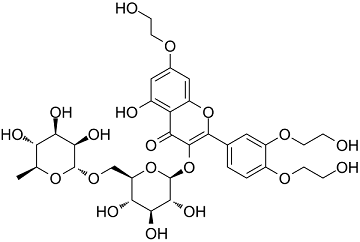
Troxerutin, also known as vitamin P4, is a tri-hydroxyethylated derivative of natural bioflavonoid rutins which can inhibit the production of reactive oxygen species (ROS) and depress ER stress-mediated NOD activation. Pretreatment with Troxerutin (5 and 10 μM) causes a decrease in the number of cells in the sub G1 phase, indicative of cell death. In the control and Troxerutin-only-treated cells, 3.58±0.15 and 0.89±0.11% are 2′7′-dichlorofluorescein (DCF)-positive (P<0.05), whereas treatment with H2O2 alone increases the level of ROS to 46.36±2.33%. The cells pretreated with Troxerutin are 19.92±1.95% DCF-positive following H2O2 treatment, indicating that Troxerutin reduces the H2O2-induced production of ROS in the HDP cells. Oral administration of Troxerutin notably inhibits those liver injuries in HFD-treated mice, restores glucose intolerance and insulin signaling, and diminishes hepatic gluconeogenesis in HFD-treated mice. Troxerutin remarkably inhibits the nuclear translocation of NF-κB p65, as well as the expressions of its target genes, in the livers of HFD-treated mice. Troxerutin also depresses endoplasmic reticulum (ER) stress-mediated Nucleotide oligomerization domain (NOD) activation in HFD-treated mouse livers.
| Molecular Weight | 742.68 |
| Formula | C33H42O19 |
| CAS Number | 7085-55-4 |
| Solubility (25°C) | Soluble in Water Soluble in DMSO |
| Storage | -20°C, sealed |
| Related NLR Products |
|---|
| Nodinitib-1
Nodinitib-1 (ML130) is a potent and selective inhibitor of NOD1 with IC50 of 0.56 μM, inhibits NF-κB activation, exhibits 36-fold selectivity over NOD2. |
| Ruscogenin
Ruscogenin is an important steroid saponin extracted from Ophiopogon japonicum. It alleviates blood-brain barrier dysfunction induced by cerebral ischemia by inhibiting TXNIP/NLRP3 inflammatory body activation and MAPK pathway, and has significant anti-inflammatory and antithrombotic activities. |
| Procyanidin-B2
Procyanidin B2 is a natural flavonoid with anti-tumor and anti-oxidation effects. Procyanidin B2 inhibited NLRP3 inflammasome activation via suppression of AP-1 pathway. |
| Oridonin
Oridonin is a covalent NLRP3 inhibitor with strong anti-inflammasome activity. Oridonin (NSC-250682) also acts as an inhibitor of AKT, with IC50 values of 8.4 and 8.9 μM for AKT1 and AKT2, respectively. |
| Shionone
Shionone, isolated from Aster Tataricus, is a triterpenoid compound with antitussive and anti-inflammatory activities. Shionone has a unique six-membered four-ring framework and a 3-oxygen-4-monomethyl structure. |
All AbMole products are for research use only, cannot be used for human consumption or veterinary use. We do not provide products or services to individuals. Please comply with the intended use and do not use AbMole products for any other purpose.


Products are for research use only. Not for human use. We do not sell to patients.
© Copyright 2010-2026 AbMole BioScience. All Rights Reserved.
