
All AbMole products are for research use only, cannot be used for human consumption.

Trichostatin A (TSA) is a potent and specific inhibitor of mammalian histone deacetylase (HDAC) class I/II, with an IC50 value of 1.8 nM for HDAC. Trichostatin A (TSA) is an antifungal antibiotic derived from Streptomyces that inhibits mammalian histone deacetylase (HDAC). TSA inhibits the eukaryotic cell cycle during the beginning of the growth stage. Trichostatin A (TSA) can be used to alter gene expression by interfering with the removal of acetyl groups from histones (histone deacetylases, HDAC) and therefore altering the ability of DNA transcription factors to access the DNA molecules inside chromatin. It is a member of a larger class of histone deacetylase inhibitors (HDIs or HDACIs) that have a broad spectrum of epigenetic activities. Trichostatin A has also been shown to inhibit both G1- and G2-phases of the mammalian cell cycle and has been tested for use as a potential anticancer agent.

Cell Death Differ. 2026 Jan 31; .
Targeting the USP7-PRMT6 epigenetic axis overcomes chemoresistance in breast cancer by coordinating H3R2me2a deposition and RNF168 methylation for DNA
Trichostatin A purchased from AbMole
Sci Immunol. 2025 Oct 03;10(112):eadu6730.
Vaccination-induced T cell responses maintain polyclonality with high antigen receptor avidity
Trichostatin A purchased from AbMole
iScience. 2025 Feb 05.
Coronavirus replicase epitopes induce cross-reactive CD8 T cell responses in SARS-CoV-2-naive people with HIV-1
Trichostatin A purchased from AbMole
BioRxiv. 2025 Oct 07;680634.
TCR activation impairs CAR-T cytotoxicity against separate target cells
Trichostatin A purchased from AbMole
BioRxiv. 2025 Nov 19;688845.
Antigen-reactive CD4+ T cells after SARS-CoV-2 vaccination show divergent phenotypic states with or without restimulation bias
Trichostatin A purchased from AbMole
BioRxiv. 2025 Feb 06;636644.
Glycolytic flux sustains human Th1 identity and effector function via STAT1 glycosylation
Trichostatin A purchased from AbMole
Advanced Science. 2024 Aug 13.
Dissecting the Distinct Tumor Microenvironments of HRD and HRP Ovarian Cancer: Implications for Targeted Therapies to Overcome PARPi Resistance in HRD Tumors and Refractoriness in HRP Tumors
Trichostatin A purchased from AbMole
BioRxiv. 2024 Oct 30;620795.
Quality of vaccination-induced T cell responses is conveyed by polyclonality and high, but not maximum, antigen receptor avidity
Trichostatin A purchased from AbMole
BioRxiv. 2024 Nov 01.
Quality of vaccination-induced T cell responses is conveyed by polyclonality and high, but not maximum, antigen receptor avidity
Trichostatin A purchased from AbMole
BioRxiv. 2023 May 28;542585.
Imaging the microscopic viscoelastic anisotropy in living cells
Trichostatin A purchased from AbMole
bioRxiv. 2023 May 30.
Imaging the microscopic viscoelastic anisotropy in living cells
Trichostatin A purchased from AbMole
University of Otago. 2019.
Transcriptional effects of mood stabiliser drugs in a serotonergic cell line
Trichostatin A purchased from AbMole
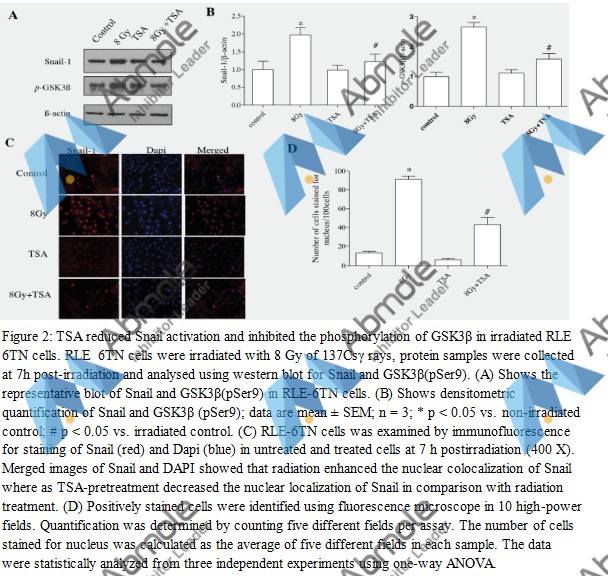 |
Source | Oncotarget (2017). Figure 2. Trichostatin A |
| Method | Western blotting | |
| Cell Lines | RLE-6TN cells | |
| Concentrations | 100 nM | |
| Incubation Time | 72 h | |
| Results | Snail was significantly increased in irradiated group which was effectively modulated by the treatment of TSA, as we observed from the data of western blot |
 |
Source | Oncotarget (2017). Figure 1. Trichostatin A |
| Method | Western blotting | |
| Cell Lines | RLE-6TN cells | |
| Concentrations | 100 nM | |
| Incubation Time | 72 h | |
| Results | TSA led to a significant modification in the protein and gene expressions of both E-cadherin and α-SMA in cells collected at 72 h after irradation. |
| Cell Experiment | |
|---|---|
| Cell lines | MCF-7, T-47D, ZR-75-1, BT-474, MDA-MB-231, MDA-MB-453, CAL 51, and SK-BR-3 cell lines |
| Preparation method | Cell Proliferation Assay. Stock cultures of breast cancer cell lines MCF-7, T-47D, ZR-75-1, BT-474, MDA-MB-231, MDA-MB-453, CAL 51, and SK-BR-3 were grown in DMEM containing 10% (v/v) FCS, 2 mM L-glutamine, 100 units/ml penicillin, and 100 mg/ml streptomycin at 37°C in 5% CO2 humidified atmosphere. Cells were counted in a hemocytometer after detachment using 0.25% (w/v) trypsin in Dulbecco’s PBS without Ca21 or Mg21 containing 0.02% (w/v) EDTA. Viability was determined by trypan blue exclusion. For each cell line, cells were seeded in 96-well microtiter plates at optimal densities determined in prior experiments to ensure exponential growth for the duration of the assay. After a 24-h preincubation, growth medium was replaced with experimental medium containing TSA at final concentrations ranging from 10-12 M to 10-5 M in log dilutions and 0.1% (v/v) ethanol, or growth medium containing 0.1% (v/v) ethanol as a vehicle control. After 96 h incubation, cell proliferation was estimated using the sulforhodamine B colorimetric assay (11), and the results are expressed as the mean 6 SD for six replicates as a percentage of vehicle control (taken as 100%). |
| Concentrations | 10-12 M to 10-5 M |
| Incubation time | 96 h |
| Animal Experiment | |
|---|---|
| Animal models | Inbred virgin female (Ludwig/Wistar/ Olac) rats bearing tumors induced with NMU model |
| Formulation | DMSO |
| Dosages | 500 µg/kg TSA in50 µl DMSO twice weekly for 4 weeks |
| Administration | s.c. injection |
| Molecular Weight | 302.37 |
| Formula | C17H22N2O3 |
| CAS Number | 58880-19-6 |
| Solubility (25°C) | DMSO 23 mg/mL |
| Storage |
Powder -20°C 3 years ; 4°C 2 years In solvent -80°C 6 months ; -20°C 1 month |
| Related HDAC Products |
|---|
| Belinostat
Belinostat (PXD101) is a novel HDAC inhibitor with an IC50 of 27 nM. |
| CUDC-101
CUDC-101 is a potent multitargeted HDAC, EGFR and HER2 inhibitor with IC50 of 4.4, 2.4, and 15.7 nM, respectively. |
| Givinostat hydrochloride monohydrate
ITF2357 (Givinostat, Gavinostat) is a histone deacetylase inhibitor. The IC50 values for maize HDAC preparations HD2, HD-1B and HD-1A are 10, 7.5 and 16 nM respectively. |
| Niltubacin
Niltubacin, as an inactive derivative of Tubacin, is a highly potent and selective, reversible cell-permeable inhibitor of HDAC6. |
| Tubacin
Tubacin (Tubulin Acetylation Inducer) is a highly potent and selective, reversible cell-permeable inhibitor of HDAC6 with IC50 of 0.004µM. |
All AbMole products are for research use only, cannot be used for human consumption or veterinary use. We do not provide products or services to individuals. Please comply with the intended use and do not use AbMole products for any other purpose.


Products are for research use only. Not for human use. We do not sell to patients.
© Copyright 2010-2026 AbMole BioScience. All Rights Reserved.
