
All AbMole products are for research use only, cannot be used for human consumption.
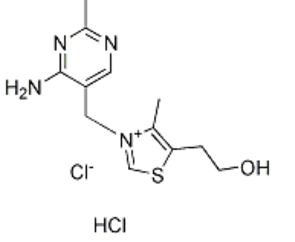
In vitro: Thiamine (50 mM), in addition to its nutritional value, induces systemic acquired resistance (SAR) in rice, tobacco, cucumber, and Arabidopsis. Thiamine-treated rice, Arabidopsis (Arabidopsis thaliana), and vegetable crop plants shows resistance to fungal, bacterial, and viral infections. Thiamine treatment induces the transient expression of pathogenesis-related (PR) genes in rice and other plants. In addition, Thiamine treatment potentiates stronger and more rapid PR gene expression and the up-regulation of protein kinase C activity. Vitamin B1 (10 μM) prevents acetaldehyde-induced inhibition of myocyte shortening in adult rat ventricular myocytes. Vitamin B1 (10 μM) effectively blunts the acetaldehyde-induced depression in ±dL/dt in adult rat ventricular myocytes. Vitamin B1 (10 μM) prevents acetaldehyde-induced shortening of time-to-peak shortening in adult rat ventricular myocytes. Vitamin B1 (10 μM) prevents acetaldehyde-induced elevation in both protein carbonyl formation and caspase-3 activation in adult rat ventricular myocytes. Thiamine uptake is energy- and temperature-dependent, pH-sensitive, Na+-independent, saturable at both the nanomolar (apparent Km, 30 nM) and the micromolar (apparent Km, 1.72 mM) concentration ranges in ARPE-19 cells. Uptake of Thiamine is adaptively regulated by extracellular substrate level via transcriptionally mediated mechanisms that involve both hTHTR-1 and hTHTR-2 in ARPE-19 cells, it is also regulated by an intracellular Ca2+-calmodulin-mediated pathway. Thiamine-responsive megaloblastic anemia (TRMA) fibroblasts are rescued from death with 10 nM-30 nM Thiamine (in the range of normal plasma thiamine concentrations). Normal fibroblasts exhibits saturable, high-affinity thiamine uptake (Km 400 nM-550 nM; Vmax 11 pmol/min/1×106 cells), while TRMA fibroblasts lacks detectable high-affinity uptake. At 30 nM Thiamine, the rate of uptake of Thiamine by TRMA fibroblasts is 10-fold less than that of wild-type, which explains the increased apoptosis of TRMA fibroblasts.
In vivo: Thiamine deficiency results in amyloid precursor protein immunoreactivity accumulated in swollen neurites within, or around lesions in rats, or in abnormal clusters in mice.
| Cell Experiment | |
|---|---|
| Cell lines | HL-60 cells |
| Preparation method | HL-60 cells were pre-treated with 0.25 μg/ml of either cycloheximide or tetrathylammonium, a big potassium channel (BK) blocker, for 2 hours and then cultured for 12 hours with or without thiamine (100 μM) and stained with Giemsa. |
| Concentrations | 100 μM |
| Incubation time | 12 h |
| Animal Experiment | |
|---|---|
| Animal models | |
| Formulation | |
| Dosages | |
| Administration | |
| Molecular Weight | 337.27 |
| Formula | C12H17N4OS.HCl |
| CAS Number | 67-03-8 |
| Solubility (25°C) | Water 90 mg/mL |
| Storage | 4°C, protect from light, dry, sealed |
| Related Vitamin Products |
|---|
| Calcifediol
Calcifediol is a prehormone that is produced in the liver by hydroxylation of vitamin D3 (cholecalciferol) by the enzyme cholecalciferol 25-hydroxylase. |
| Vitamin C (L-Ascorbic Acid)
Vitamin C (L-Ascorbic Acid) is a water-soluble vitamin indicated for the prevention and treatment of scurvy. |
| Lipoic acid
Lipoic acid is a class of compounds belonging to the B class vitamins and is the growth factor of yeast and some kinds of microorganisms. |
| Paricalcitol
Paricalcitol, an analog of 1,25-dihydroxyvitamin D3 with lower calcemic activity, against uterine fibroids using in vitro and in vivo evaluations in appropriate uterine fibroid cells and animal models. |
| Tacalcitol
Tacalcitol is a synthetic vitamin D3 analog. |
All AbMole products are for research use only, cannot be used for human consumption or veterinary use. We do not provide products or services to individuals. Please comply with the intended use and do not use AbMole products for any other purpose.


Products are for research use only. Not for human use. We do not sell to patients.
© Copyright 2010-2026 AbMole BioScience. All Rights Reserved.
