
All AbMole products are for research use only, cannot be used for human consumption.
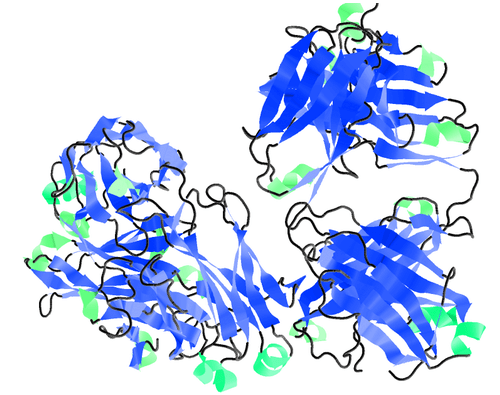
In vitro: Complement-dependent cytotoxicity(CDC), complement-dependent cellular cytotoxicity(CDCC), antibody-dependent cytotoxicity (ADCC) as well as the induction of apoptosis have been claimed to be responsible for the efficacy of rituximab. Rituximab can induce death of malignant B cell lines in vitro. Th strength of this effect varies considerably between target cell lines. Changes that have been identified in response to rituximab in vitro include inhibition of p38 mitogen-activated protein kinase, NF-κB, extracellular signal-regulated kinase 1/2 (ERK 1/2) and AKT antiapoptotic survival pathways. Rituximab is highly efficient at mediating CMC(complement dependent cytotoxicity) of various B cell lines as well as fresh malignant B cell samples. CD20-binding capacity of rituximab is dose-dependentv.
In vivo: A number of in vivo tumor models suggest the anti-tumor activity of rituximab is dependent, at least in part, on complement. Rituximab can deplete B cells for several months and, as such, could represent an effective therapy for B cell-mediated autoimmune diseases. Rituximab is now widely used in onco-haematology and is currently in development in several autoimmune diseases.

Talanta. 2025 Apr 1;285:127431.
Biologically-driven RAFT polymerization-amplified platform for electrochemical detection of antibody drugs
Rituximab purchased from AbMole
Anal Chem. 2023 Sep 19;95(37):14094-14100.
Amplification-Free Ratiometric Electrochemical Aptasensor for Point-of-Care Detection of Therapeutic Monoclonal Antibodies
Rituximab purchased from AbMole
| Cell Experiment | |
|---|---|
| Cell lines | Two CD20-positive follicular lymphoma cell lines (DOHH-2, WSU-NHL) and one CD20-positive Burkitt's lymphoma cell line (Raji) |
| Preparation method | Samples of 1×10^6 cells/mL medium are incubated with rituximab and the various cytotoxic drugs for 24 and 48 hours. |
| Concentrations | 10 µg/mL |
| Incubation time | 24 and 48 hours |
| Animal Experiment | |
|---|---|
| Animal models | SCID mice |
| Formulation | saline |
| Dosages | 200 μg |
| Administration | i.v. |
| Molecular Weight | 143857.63 |
| Formula | C6416H9874N1688O1987S44 |
| CAS Number | 174722-31-7 |
| Storage | -80°C for long term |
| Related CD20 Products |
|---|
| Obinutuzumab
Obinutuzumab (GA101) is a fully humanized monoclonal antibody that binds to an epitope on CD20. |
| Ofatumumab
Ofatumumab is a humanised anti-CD20 monoclonal antibody, which appears to inhibit early-stage B lymphocyte activation. |
| Tositumomab
Tositumomab is a murine IgG2a lambda monoclonal antibody directed against the CD20 antigen, which is found on the surface of normal and malignant B lymphocytes. |
| Glofitamab
Glofitamab (RO7082859) is a T-cell-engaging bispecific antibody possessing a novel 2:1 structure with bivalency for CD20 on B cells and monovalency for CD3 on T cells. Glofitamab leads to T-cell activation, proliferation, and tumor cell killing upon binding to CD20 on malignant cells. Glofitamab induces durable complete remissions in relapsed or refractory B-Cell lymphoma. |
| Ripertamab
Ripertamab (SCT400) is a recombinant, human-mouse chimeric anti-CD20 IgG1κ mAb. Ripertamab can be used for the research of hematological malignancies, including non-Hodgkin’s lymphoma (NHL). |
All AbMole products are for research use only, cannot be used for human consumption or veterinary use. We do not provide products or services to individuals. Please comply with the intended use and do not use AbMole products for any other purpose.


Products are for research use only. Not for human use. We do not sell to patients.
© Copyright 2010-2026 AbMole BioScience. All Rights Reserved.
