
All AbMole products are for research use only, cannot be used for human consumption.
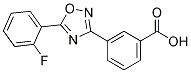
Ataluren (PTC124) is a novel small molecular CFTR-G542X nonsense allele inhibitor. In safety pharmacology studies in rats and dogs, oral administration of PTC124 (Ataluren) induces no adverse neurological, pulmonary, or cardiovascular effects at doses through 1500 mg/kg. In toxicology studies in rats and dogs at oral doses through 1500 mg/kg for 28 days, PTC124 (Ataluren) has shown good tolerability. Both PTC124 doses were similarly active, improving total chloride transport with a combined mean change of -5.4 mV (p<0.001), and on-treatment responses (at least -5 mV improvement) and hyperpolarisations (values more electrically negative than -5 mV) in 61% (p<0.001) and 56% (p = 0.002) of patients. CFTR function was greater with time and was accompanied by trends toward improvements in pulmonary function and CF-related coughing. The high readthrough efficiency of PTC124 in combination with excellent biocompatibility makes it a promising therapeutic agent for PTCs in USH1C.
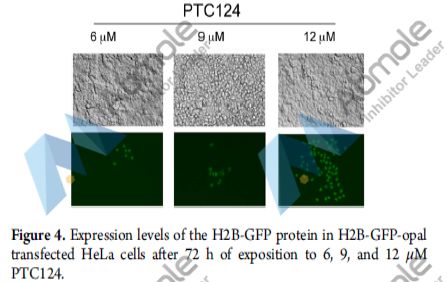 |
Source | Mol Pharm (2014). Figure 4. PTC124 |
| Method | fluorescence microscopy | |
| Cell Lines | HeLa FLuc-opal cell | |
| Concentrations | 6, 9, and 12 μM | |
| Incubation Time | 72 h | |
| Results | After exposition of HeLa cells to 6 μM, 9 μM, and 12 μM PTC124 we observed the presence of green cells indicating that PTC124 induced the production of a full length functional H2B-GFP protein, despite the presence of a premature stop codon in its coding sequence, as evidenced by the clearly dose-dependent increase in the number of green cells. |
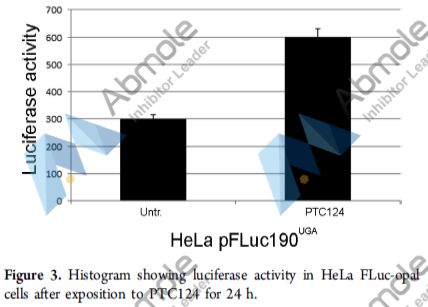 |
Source | Mol Pharm (2014). Figure 3. PTC124 |
| Method | luciferase activity assay | |
| Cell Lines | HeLa FLuc-opal cell | |
| Concentrations | 12 μM | |
| Incubation Time | 24 h | |
| Results | Following PTC124 exposition pFLuc190UGA transfected HeLa cells showed an increase of luciferase activity, this result is consistent with what previously published |
| Cell Experiment | |
|---|---|
| Cell lines | Grip-Tite 293 cells transfected with the pFLuc190UGA construct |
| Preparation method | Luciferase Reporter Assays. All cell-based assays were performed in 1,536-well plates with an assay volume of 4.5 μL per well. Comparative cell-based experiments were performed with cells from the same batch of transfected cells to control for transfection efficiency. Cells were incubated with compound or antibiotic for 16–72 h. In experiments with Grip-Tite cells, cells were washed with PBS before the addition of detection reagent containing the FLuc or RLuc substrate. Luminescence from luciferase activity was detected by using ViewLux (PerkinElmer). Experimental plates contained the transcriptional activator MS-275 as a positive control and DMSO-treated cells or mock-transfected cells as a negative control. Percentage activity was defined as the percentage signal above DMSO-treated cells. |
| Concentrations | 0~100μM |
| Incubation time | 24 hr |
| Animal Experiment | |
|---|---|
| Animal models | Cftr−/− hCFTR-G542X mice |
| Formulation | saline |
| Dosages | 15, 30 or 60mg/kg initiated 16 days after birth and continued once daily until the animals were killed |
| Administration | Subcutaneous injections |
| Molecular Weight | 284.24 |
| Formula | C15H9FN2O3 |
| CAS Number | 775304-57-9 |
| Solubility (25°C) | DMSO ≥47 mg/mL |
| Storage |
Powder -20°C 3 years ; 4°C 2 years In solvent -80°C 6 months ; -20°C 1 month |
| Related CFTR Products |
|---|
| VX-770 (Ivacaftor)
VX-770 (Ivacaftor) is a first-in-class potentiator of CFTR, which targeting G551D-CFTR and F508del-CFTR with EC50 of 100 nM and 25 nM, respectively. |
| Lonidamine
Lonidamine (AF-1890) is a novel CFTR open channel blocker with an IC50 of 0.85 mM, which inhibits aerobic glycolysis in cancer cells. Lonidamine (AF-1890) is a hexokinase and mitochondrial pyruvate carrier inhibitor (Ki=2.5 μM). |
| VX-809
VX-809 is a CFTR corrector that improves CFTR processing and maturation in the cell. |
| CFTR(inh)-172
CFTR(inh)-172 is a voltage-independent, selective CFTR inhibitor with Ki of 300 nM, showing no effects on MDR1, ATP-sensitive K+ channels, or a series of other transporters. |
| IOWH032
IOWH032 is a synthetic CFTR inhibitor with IC50 of 1.01 μM in CHO-CFTR cell based assays. |
All AbMole products are for research use only, cannot be used for human consumption or veterinary use. We do not provide products or services to individuals. Please comply with the intended use and do not use AbMole products for any other purpose.


Products are for research use only. Not for human use. We do not sell to patients.
© Copyright 2010-2026 AbMole BioScience. All Rights Reserved.
