
All AbMole products are for research use only, cannot be used for human consumption.
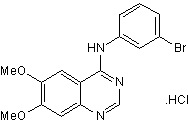
PD153035 hydrochloride (ZM 252868, AG 1517) is a potent and specific inhibitor of EGFR with Ki and IC50 of 5.2 pM and 29 pM. PD153035 HCl shows a potent and selective inhibitory effect on tyrosine phosphorylation induced with EGF with IC50 of 15 nM and 14 nM in Swiss 3T3 fibroblast and A-431 human epidermoid carcinoma cells, respectively. PD153035 induces a dose-dependent growth inhibition in nasopharyngeal carcinoma (NPC) cells including NPC-TW01, NPC-TW04, and HONE1 cell lines with IC50 of 12.9 μM, 9.8 μM and 18.6μM, respectively. PD 153035 inhibits other purified tyrosine kinases only at micromolar or higher concentrations.
| Cell Experiment | |
|---|---|
| Cell lines | A431, Difi, DU145, MDA-MB-468 and ME180 |
| Preparation method | Seeding cells in sixwell plates. The next day, changing cells to medium containing 0.5% FBS for 18 hours, and then adding PD153035 at various concentrations to the cultures. After 72 hours of treatment, washing cells once with PBS, harvesting with 0.1% human trypsin-l mM EDTA in PBS, and counting with a Coulter counter. The CMK cells grow in suspension and, therefore, do not require trypsinization. |
| Concentrations | 0-3 μM |
| Incubation time | 72 hours |
| Animal Experiment | |
|---|---|
| Animal models | A431 cells are injected into the outbred nude mice |
| Formulation | PD153035 is dissolved in water. |
| Dosages | ≤80 mg/kg |
| Administration | Administered via i.p. |
| Molecular Weight | 396.67 |
| Formula | C16H14BrN3O2.HCl |
| CAS Number | 183322-45-4 |
| Solubility (25°C) | DMSO 4 mg/mL (Need ultrasonic and warming) |
| Storage |
Powder -20°C 3 years ; 4°C 2 years In solvent -80°C 6 months ; -20°C 1 month |
| Related EGFR/HER2 Products |
|---|
| Panitumumab
Panitumumab is a fully human IgG2 monoclonal antibody specific to the epidermal growth factor receptor (EGFR). |
| Nimotuzumab
Nimotuzumab (Nimotuzumab) is the first humanized monoclonal antibody targeting epidermal growth factor receptor (EGFR). Nimotuzumab has cytolytic effects on target tumors through its ability to induce antibody-dependent cell-mediated cytotoxicity (ADCC) and complement dependent cytotoxicity (CDC). Nimotuzumab failed to recognize mouse EGFR. |
| Matuzumab
Matuzumab (EMD 72000) is a humanized monoclonal antibody that binds tightly to EGFR. |
| AEE788
AEE788 (NVP-AEE788) is a novel multitargeted HER 1/2 and VEGFR 1/2 receptor family tyrosine kinases inhibitor with IC50 of 2, 6, 77, 59 nM for EGFR, ErbB2, KDR, and Flt-1. |
| Sapitinib (AZD8931)
AZD8931 (Sapitinib) is an equipotent, reversible inhibitor of Signaling by EGFR, ERBB2 (HER2), and ERBB3 with IC50 of 4, 3, 4 nM respectively. |
All AbMole products are for research use only, cannot be used for human consumption or veterinary use. We do not provide products or services to individuals. Please comply with the intended use and do not use AbMole products for any other purpose.


Products are for research use only. Not for human use. We do not sell to patients.
© Copyright 2010-2026 AbMole BioScience. All Rights Reserved.
