
All AbMole products are for research use only, cannot be used for human consumption.

Paricalcitol has potential to reduce the proliferation of the immortalized human uterine fibroid cells.Paricalcitol activates the vitamin D receptorPricalcitol may be a potential candidate for effective, safe, and noninvasive medical treatment option for uterine fibroids.
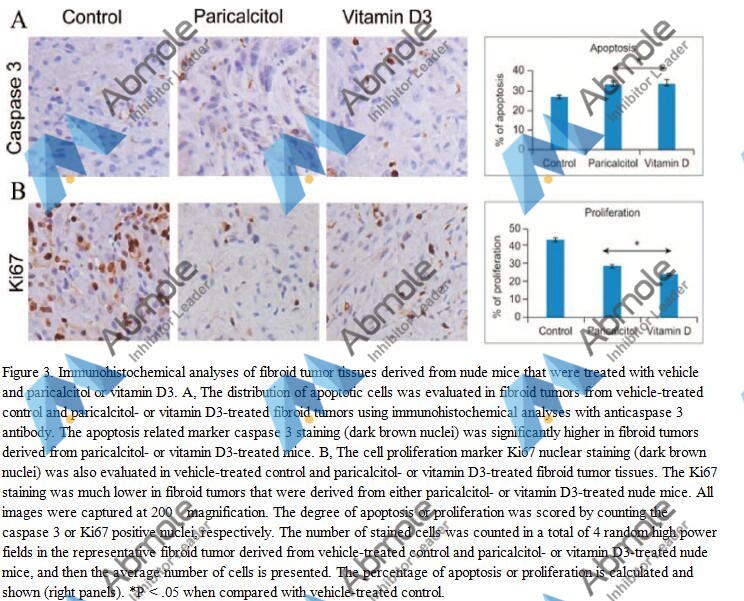 |
Source | Reprod Sci (2014). Figure 3. Paricalcitol |
| Method | Immunohistochemical analyses | |
| Cell Lines | nude mice | |
| Concentrations | 300 ng/kg/d | |
| Incubation Time | 4 consecutive weeks | |
| Results | Paricalcitol treatment produced a 66% reduction in cell proliferation, whereas 1,25-dihydroxyvitamin D3 produced a 56% reduction |
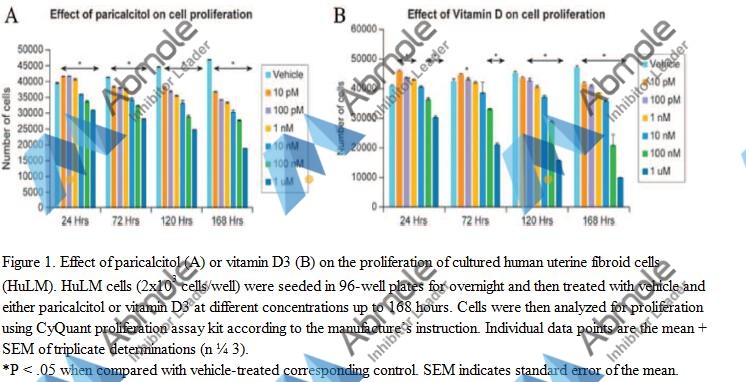 |
Source | Reprod Sci (2014). Figure 1. Paricalcitol |
| Method | proliferation assay | |
| Cell Lines | HuLM cells | |
| Concentrations | 10 nmol/L | |
| Incubation Time | 168 h | |
| Results | We found that after 24 hours of treatment, paricalcitol reduced HuLM cell proliferation up to 9%at a 10 nmol/L concentration (P < .05),whereas vitamin D3 reduced proliferation only by 1% at the same concentration, and the reduction was not significant |
| Cell Experiment | |
|---|---|
| Cell lines | HuLM cells |
| Preparation method | Once these cells were approximately 70% confluent in culture medium, the media were replaced by Dulbecco Modified Eagle Medium: Nutrient Mixture F-12 (DMEM/F12; phenol free) supplemented with 10% charcoal-stripped FBS and 10 nmol/L estradiol and treated with various concentrations of paricalcitol and 1,25-dihydroxyvitamin D3 in the range of 10 pmol/L to 1000 nmol/L at different time intervals for up to 168 hours. The effects of paricalcitol and 1,25-dihydroxyvitamin D3 on HuLM cell proliferation were assessed using a CyQuant cell proliferation assay kit |
| Concentrations | 10 pmol/L to 1000 nmol/L |
| Incubation time | 168 h |
| Animal Experiment | |
|---|---|
| Animal models | Eker rat |
| Formulation | Propylene glycol |
| Dosages | 300 ng/kg/d |
| Administration | i.p. |
| Molecular Weight | 416.64 |
| Formula | C27H44O3 |
| CAS Number | 131918-61-1 |
| Solubility (25°C) | DMSO |
| Storage |
Powder -20°C 3 years ; 4°C 2 years In solvent -80°C 6 months ; -20°C 1 month |
| Related Vitamin Products |
|---|
| Calcifediol
Calcifediol is a prehormone that is produced in the liver by hydroxylation of vitamin D3 (cholecalciferol) by the enzyme cholecalciferol 25-hydroxylase. |
| Vitamin C (L-Ascorbic Acid)
Vitamin C (L-Ascorbic Acid) is a water-soluble vitamin indicated for the prevention and treatment of scurvy. |
| Lipoic acid
Lipoic acid is a class of compounds belonging to the B class vitamins and is the growth factor of yeast and some kinds of microorganisms. |
| Tacalcitol
Tacalcitol is a synthetic vitamin D3 analog. |
| Alfacalcidol
Alfacalcidol (1-hydroxycholecalciferol) is a vitamin D active metabolites, acts as a non-selective VDR activator medication, and widely be used in the management of osteoporosis. |
All AbMole products are for research use only, cannot be used for human consumption or veterinary use. We do not provide products or services to individuals. Please comply with the intended use and do not use AbMole products for any other purpose.


Products are for research use only. Not for human use. We do not sell to patients.
© Copyright 2010-2026 AbMole BioScience. All Rights Reserved.
