
All AbMole products are for research use only, cannot be used for human consumption.
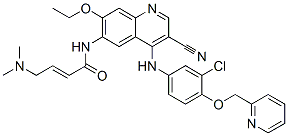
Neratinib is a potent irreversible inhibitor of epidermal growth factor receptor and human epidermal receptor 2 with IC50 of 92 nM and 59 nM, respectively. Neratinib inhibits the proliferation of EGFR-dependent A431 cells with an IC50 of 81 nM. Neratinib (HKI-272) also weakly inhibits tyrosine kinases KDR and Src with IC50 of 0.8 μM and 1.4 μM, respectively. Likewise, Neratinib inhibited the photolabeling of ABCB1 with [(125)I]iodoarylazidoprazosin in a concentration-dependent manner (IC50 = 0.24 μM). Neratinib enhanced the sensitivity of ABCB1-overexpressing cells to ABCB1 substrates. It is noteworthy that Neratinib augmented the effect of chemotherapeutic agents in inhibiting the growth of ABCB1-overexpressing primary leukemia blasts and KBv200 cell xenografts in nude mice. Moreover, Neratinib increased doxorubicin accumulation in ABCB1-overexpressing cell lines and Rhodamine 123 accumulation in ABCB1-overexpressing cell lines and primary leukemia blasts. Neratinib (HKI-272) stimulated the ATPase activity of ABCB1 at low concentrations but inhibited it at high concentrations.

J Pharm Pharmacogn Res. 2025 Jan 14;13 (3), 919-924.
Extract of Holothuria scabra exhibits synergistic effect with chemotherapeutic agents against breast cancer in vitro
Neratinib purchased from AbMole
Cell Death Dis. 2021 Feb 15;12(2):179.
Targeting transcription of MCL-1 sensitizes HER2-amplified breast cancers to HER2 inhibitors
Neratinib purchased from AbMole
Int J Clin Exp Med. 2019 Aug 30;12(8):10373-10379.
Neratinib inhibits the malignant phenotype via inhibiting the HER2 in osteosarcoma cells
Neratinib purchased from AbMole

ACS Chem Biol. 2016 May 20;11(5):1245-54.
Chemical Proteomics Reveals Ferrochelatase as a Common Off-target of Kinase Inhibitors
Neratinib purchased from AbMole
 |
Source | ACS Chem Biol (2016). Figure 5. Neratinib (Abmole Bioscience) |
| Method | FECH inhibition assay | |
| Cell Lines | K562 Cells | |
| Concentrations | 1 μM | |
| Incubation Time | 6 days | |
| Results | In line with the Kd values obtained from kinobead experiments, Vemurafenib, CUDC 101, Cyc-116, Linsitinib, MK-2461, Neratinib, GSK-690693, and Crenolanib decreased FECH binding to the PPIX beads by 50% or more compared to the DMSO control. |
 |
Source | ACS Chem Biol (2016). Figure 4. Neratinib (Abmole Bioscience) |
| Method | FECH inhibition assay | |
| Cell Lines | K562 Cells | |
| Concentrations | 1 μM | |
| Incubation Time | 6 days | |
| Results | We then subjected MK-2461, Neratinib, and Linsitinib to the same assay (1 μM for 6 days), and each drug clearly led to reduced heme levels indicating inhibition of FECH activity in K562 cells with Neratinib showing the most potent effect (60% reduction). |
 |
Source | ACS Chem Biol (2016). Figure 3. Neratinib (Abmole Bioscience) |
| Method | FECH binding | |
| Cell Lines | K562 Cells | |
| Concentrations | ||
| Incubation Time | ||
| Results | The basis of this assay is that proteins bound to a drug molecule are stabilized against heat induced unfolding and aggregation, and the extent of this protection is dose dependent. |
 |
Source | ACS Chem Biol (2016). Figure 2. Neratinib (Abmole Bioscience) |
| Method | FECH binding | |
| Cell Lines | ||
| Concentrations | ||
| Incubation Time | ||
| Results | Figure 2b−f show the full dose response data for five selected inhibitors, and the complete set of these plots can be found in Supporting Information Figure S1 and Table S1. |
| Cell Experiment | |
|---|---|
| Cell lines | 3T3, 3T3/neu, A431, SK-Br-3, BT474, MDA-MB-435, and SW62 cells |
| Preparation method | Cell Proliferation Assays. Cells were plated in 96-well tissue culture plates (3T3, 3T3/neu, 5000 cells/well; A431, SK-Br-3, BT474, MDA-MB-435, and SW620, 10,000 cells/well). The following day, dilutions of compound (0.5 ng/ml–5 μg/ml) were added, and cells were cultured for 2 days (6 days for BT474). Cell proliferation was determined using sulforhodamine B, a protein binding dye. Briefly, cells were fixed with 10% trichloroacetic acid and washed extensively with water. Cells were then stained with 0.1% sulforhodamine B (M11518) and washed in 5% acetic acid. Protein-associated dye was solubilized in 10 mm Tris, and absorbance was measured at 450 nm (Victor2). Inhibition of cell proliferation was calculated using the formula: percentage of inhibition = 100 − 100 (Td − To/Tc − To), where Td is the absorbance of drug treated cells, Tc is the absorbance of untreated cells, and To is the absorbance at the time of drug addition. To values were determined by plating cells separately and fixing them at the time of drug addition. The concentration of compound which inhibits cell proliferation by 50% (IC50) was determined from inhibition curves. |
| Concentrations | 0.5 ng/ml-5 μg/ml |
| Incubation time | 2 days |
| Animal Experiment | |
|---|---|
| Animal models | BT474, MCF-7, and SK-OV-3 tumour xenografts model in female athymic (nude) mice |
| Formulation | 0.5% methocellulose-0.4% polysorbate-80 (Tween 80) |
| Dosages | 40 or 60mg/kg daily for 20 days |
| Administration | oral gavage |
| Molecular Weight | 557.04 |
| Formula | C30H29ClN6O3 |
| CAS Number | 698387-09-6 |
| Solubility (25°C) | DMSO 8 mg/mL |
| Storage |
Powder -20°C 3 years ; 4°C 2 years In solvent -80°C 6 months ; -20°C 1 month |
| Related EGFR/HER2 Products |
|---|
| AEE788
AEE788 (NVP-AEE788) is a novel multitargeted HER 1/2 and VEGFR 1/2 receptor family tyrosine kinases inhibitor with IC50 of 2, 6, 77, 59 nM for EGFR, ErbB2, KDR, and Flt-1. |
| Sapitinib (AZD8931)
AZD8931 (Sapitinib) is an equipotent, reversible inhibitor of Signaling by EGFR, ERBB2 (HER2), and ERBB3 with IC50 of 4, 3, 4 nM respectively. |
| Afatinib
Afatinib (BIBW 2992) is a novel irreversible dual EGFR and HER2 tyrosine kinase inhibitor. |
| CP-724714
CP-724714 is a potent and selective orally active HER-2 tyrosine kinase inhibitor, IC50 = 3 nM. |
| Erlotinib Hydrochloride
Erlotinib is an inhibitor of human EGFR tyrosine kinase (IC50 = 2 nM) and decreases EGFR autophosphorylation in tumor cells (IC50 = 20 nM). |
All AbMole products are for research use only, cannot be used for human consumption or veterinary use. We do not provide products or services to individuals. Please comply with the intended use and do not use AbMole products for any other purpose.


Products are for research use only. Not for human use. We do not sell to patients.
© Copyright 2010-2026 AbMole BioScience. All Rights Reserved.
