
All AbMole products are for research use only, cannot be used for human consumption.
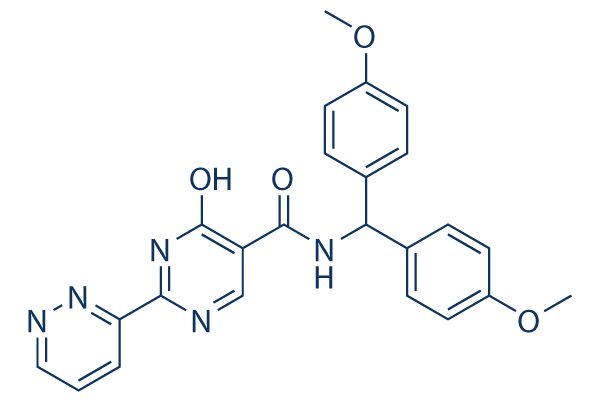
In vitro: MK-8617 is not a significant inhibitor of the cytochrome p450 enzymes in vitro (IC50), CYP1A2, 3A4, 2B6, 2C9, 2C19, or 2D6, >60 μM, and is a moderate reversible inhibitor of CYP2C8 at 1.6 μM in vitro. MK-8617 is inactive when screened at 10 μM against a general panel of 171 radioligand binding and enzymatic assays. In vivo: Tritiated MK-8617 exhibits minimal metabolic turnover in liver microsomes (+NADPH) from rat, dog, and monkey (<10% turover) but significant turnover in human liver microsomes (34% turnover) after 60 min (10 μM compound, 1 mg/mL microsomal protein). In terms of its pharmacokinetic profile, MK-8617 shows good oral bioavailability across species (36−71%), with low clearance and volume of distribution. The compound still has a relatively long elimination half-life across preclinical species. In mice (C57Bl/6), single doses of 5 and 15 mpk po (n = 3) causes increases in circulating reticulocytes measured on both 3 and 4 days postcompound challenge. In rat (Sprague−Dawley), a single dose titration of 1.5, 5, and 15 mpk po (n = 5) causes a large increase in serum erythropoietin(EPO) levels of 1.7-, 8-, and 204-fold relative to vehicle, respectively. Increases in circulating reticulocytes are observed at 5 and 15 mg/kg 3 days after challenge and, with the 15 mg dose, at 4 days after challenge.
| Cell Experiment | |
|---|---|
| Cell lines | |
| Preparation method | |
| Concentrations | |
| Incubation time | |
| Animal Experiment | |
|---|---|
| Animal models | C57Bl/6 mice |
| Formulation | DMSO/PEG400/water (5:40:55, v/v/v) |
| Dosages | 1 mg/kg po, 0.5 mg/kg iv |
| Administration | i.v or p.o |
| Molecular Weight | 443.45 |
| Formula | C24H21N5O4 |
| CAS Number | 1187990-87-9 |
| Solubility (25°C) | 88 mg/mL in DMSO |
| Storage |
Powder -20°C 3 years ; 4°C 2 years In solvent -80°C 6 months ; -20°C 1 month |
| Related HIF Products |
|---|
| FG-4592 (Roxadustat)
FG-4592 (Roxadustat; ASP1517) is a novel Hypoxia Inducible Factor Prolyl Hydroxylase inhibitor. |
| 2-Methoxyestradiol
2-methoxyestradiol (2-ME2), an endogenous metabolite of 17β -estradiol (E2) with oral activity, is an apoptosis inducer and angiogenesis inhibitor with effective antitumor activity. Methoxyestradiol can also destabilize microtubules. Methoxyestradiol is a potent inhibitor of superoxide dismutase (SOD) and reactive oxygen species (ROS) that can induce autophagy in transformed cell line HEK293, cancer cell line U87 and HeLa. |
| DMOG
DMOG (Dimethyloxaloyl glycine) is an antagonist of α-ketoglutarate cofactor and a cell permeable and competitive inhibitor of HIF-PH, which results in HIF-1α stabilisation and accmulation in vitro and in vivo. DMOG acts as a pro-angiogenic agent and plays a protective role in experimental model of colitis and diarrhoea via HIF-1 related signal. DMOG induces cell autophagy. |
| IOX2
IOX2 is a potent inhibitor of HIF-1α prolyl hydroxylase-2 (PHD2) with IC50 of 21 nM, >100-fold selectivity over JMJD2A, JMJD2C, JMJD2E, JMJD3, or the 2OG oxygenase FIH. |
| Hydralazine hydrochloride
Hydralazine hydrochloride is a hydrochloride salt of hydralazine (Apresoline) that is a direct-acting smooth muscle relaxant with an IC50 of 1.9 mM. |
All AbMole products are for research use only, cannot be used for human consumption or veterinary use. We do not provide products or services to individuals. Please comply with the intended use and do not use AbMole products for any other purpose.


Products are for research use only. Not for human use. We do not sell to patients.
© Copyright 2010-2026 AbMole BioScience. All Rights Reserved.
