
All AbMole products are for research use only, cannot be used for human consumption.
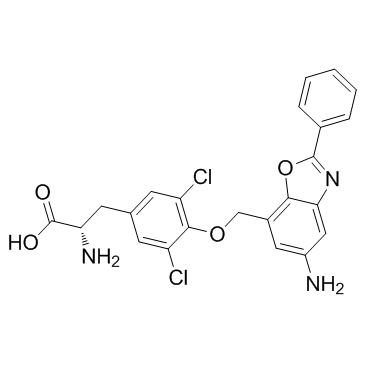
In vitro: JPH203 completely and slightly inhibits the L-Leucine uptake in YD-38 cells (IC50 value: 0.79 μM) and NHOKs (IC50 value: >100 μM), respectively. JPH203 inhibits HT-29 cell growth, generating an apparent IC50 of 4.1 μM, but the JPH203 IC50 concentration (0.06 μM) needed to inhibit the L-Leucine uptake does not inhibit HT-29 cell growth, which represents a 68-fold difference in susceptibility. JPH203 activates the mitochondria-dependent apoptotic signaling pathway by upregulating pro-apoptotic factors, such as Bad, Bax, and Bak, and the active form of caspase-9, and downregulating anti-apoptotic factors, such as Bcl-2 and Bcl-xL in Saos2 human osteosarcoma cells. JPH203 can distinguish relative abundance between LAT1 and LAT2. It has high selectivity for LAT1. JPH203 is metabolically stable in mouse, rat, dog, monkey and human liver microsomal incubations. JPH203 induces both G2/M and G0/G1 cell cycle arrest, as well as reduces the S phase accompanied by altered expression of the proteins in cell cycle progression: cyclin D1, CDK4, and CDK6.
In vivo: Daily intravenous administration of JPH203 (12.5 and 25 mg/kg) significantly inhibits tumor growth in KKU-213 cholangiocarcinoma cell xenografts in the nude mice model in a dose-dependent manner with no statistically significant change in the animal’s body weight and with no differences in the histology and appearance of the internal organs compared with the control group. Thus, JPH203 shows anti-tumor efficacy in nude mice bearing human CCA cell xenografts without general toxicity.

Diabetologia. 2025 Aug 16; .
BCKDK accelerates the progression of diabetic kidney disease by regulating leucine-mediated metabolic remodelling in renal tubular cells
JPH203 purchased from AbMole
Int J Mol Sci. 2022 Mar 26;23(7):3637.
Functional characterization of the solute carrier LAT-1 (SLC7A5/SLC2A3) in human brain capillary endothelial cells with rapid UPLC-MS/MS quantification of
JPH203 purchased from AbMole
| Cell Experiment | |
|---|---|
| Cell lines | Saos2 human osteosarcoma cells |
| Preparation method | Colony formation assays are performed by seeding 300 cells/well into 6 well plates. After 24 h of growth, the cells are treated with 100 µM JPH203 for 72 h. The JPH203 treatment is removed and fresh medium is added. The cells are incubated for 10 days. Thereafter, medium is removed and the cells are washed with phosphate buffered saline (PBS) and fixed with 4% paraformaldehyde for 10 min at 4℃. Sequentially, the colonies are stained with 2% crystal violet for 10 min. Finally, colonies stained by crystal violet are washed with PBS and dried at room temperature, before imaged by a digital camera. |
| Concentrations | 100 µM |
| Incubation time | 72 hours |
| Animal Experiment | |
|---|---|
| Animal models | Sprague-Dawley rats |
| Formulation | dissolved in DMSO and diluted in water |
| Dosages | 0.9-1.0 mg/kg |
| Administration | i.v. |
| Molecular Weight | 472.32 |
| Formula | C23H19Cl2N3O4 |
| CAS Number | 1037592-40-7 |
| Solubility (25°C) | DMSO ≥ 60 mg/mL |
| Storage |
Powder -20°C 3 years ; 4°C 2 years In solvent -80°C 6 months ; -20°C 1 month |
| Related Autophagy Products |
|---|
| Tacrolimus (FK506)
Tacrolimus (FK506, FR900506, Fujimycin, Prograf) is a potent, clinically-useful immunosuppressant in the same molecular class as cyclosporin A and rapamycin. *The compound is unstable in solutions, freshly prepared is recommended |
| Metformin hydrochloride
Metformin HCl is a biguanide inhibitor that reduces blood glucose mainly by inhibiting hepatic glycogen production (hepatic gluconeogenesis), while Metformin is a CD47 inhibitor in vitro. |
| Ginkgolide K
Ginkgolide K induces protective autophagy through the AMPK/mTOR/ULK1 signaling pathway. |
| Ivermectin (MK-933)
Ivermectin (MK-933) is a positive allosteric modulator of the α7 neuronal nicotinic acetylcholine receptor and the purinergic P2X4 receptor. Importin α5 inhibitor ivermectin effectively abrogates STAT1-importin α5 interactions. |
| Bergapten
Bergapten is a psoralen that can be photoactivated and is capable of crossing-linking DNA, covalently modifying proteins and lipids, and consequently inhibiting cell replication. |
All AbMole products are for research use only, cannot be used for human consumption or veterinary use. We do not provide products or services to individuals. Please comply with the intended use and do not use AbMole products for any other purpose.


Products are for research use only. Not for human use. We do not sell to patients.
© Copyright 2010-2026 AbMole BioScience. All Rights Reserved.
