
All AbMole products are for research use only, cannot be used for human consumption.
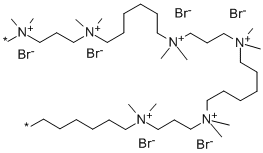
Hexadimethrine bromide can be used to transfect mammalian cells with DNA. It can be used to increase the efficiency of lipofection transfections. Hexadimethrine bromide has been used for lentivirus infection in cells. It has been used for infection of cells with retroviral supernatant.
Enhanced Transfection of Mammalian Cells with Polybrene (for reference only)
Polybrene (Cat. No. M9703) is supplied as a powder/solid and is soluble in water (up to 100 mg/mL). To generate a working solution, Polybrene should first be dissolved in 1 mL sterile water to generate a 10 mg/mL stock solution.
Polybrene working solution is generated from the polybrene stock solution (10 mg/mL in sterile water). This stock solution can be further diluted in the culture media to generate the desired working concentration for the transfection or transduction media.
Step 1: Prepare DNA Plasmid
Sufficient plasmid DNA must first be generated. Begin by amplifying the quantity of the plasmid by performing bacterial transformation. Grow the transformed bacterial culture overnight (in 37°C shaker) and extract the plasmid DNA using DNA MAXIprep kit.
Step 2: Prepare HEK Cells
Culture HEK293T cells in HEK media (DMEM/F-12 media, FBS, non-essential amino acids, L-glutamine) within humidified incubators (standard conditions of 37˚C, 5% CO2 and 21% O2). Once the culture has reached high confluency (>90%), the cells are ready for transfection.
Step 3: Prepare Transfection Media
Immediately before transfection, replace the HEK culture media with DMEM.
Prepare the transfection media, which consists of an optimized ratio of DMEM, DNA plasmid, lipofection reagent and polybrene stock solution. Typically, polybrene is used at a concentration of 4 µg/mL - 10 µg/mL.
Step 4: Transfection
Gently mix the transfection media before adding dropwise to the culture plate, to prevent damaging the cells.
Place the cells immediately in the incubator with the following settings overnight: 35˚C, 3% CO2 and 21% O2.
Step 5: Harvesting
Return culture to standard maintenance incubator. Leave the cells for 48-72 h post-transfection before proceeding to downstream application (i.e., harvesting of virus from media).

Biochem Pharmacol. 2025 Jan 05.
Peptide-based CAR-NK cells: A novel strategy for the treatment of solid tumors
Hexadimethrine bromide purchased from AbMole
Cancer Lett. 2024 Apr 6;590:216861.
TRAF6 enhances PD-L1 expression through YAP1-TFCP2 signaling in melanoma
Hexadimethrine bromide purchased from AbMole
ACS Biomater Sci Eng. 2023 Apr 12.
TNF-R1 Cellular Nanovesicles Loaded on the Thermosensitive F-127 Hydrogel Enhance the Repair of Scalded Skin
Hexadimethrine bromide purchased from AbMole
BioRxiv. 2022 Sep 28;509909.
TRAF6 modulates PD-L1 expression through YAP1-TFCP2 signaling in melanoma
Hexadimethrine bromide purchased from AbMole
bioRxiv. 2022 Sep 28.
TRAF6 modulates PD-L1 expression through YAP1-TFCP2 signaling in melanoma
Hexadimethrine bromide purchased from AbMole
| Molecular Weight | 1122.6 |
| Formula | C39H90Br6N6X2 |
| CAS Number | 28728-55-4 |
| Solubility (25°C) | Water 100 mg/mL |
| Storage | 2-8°C, protect from light, dry, sealed |
| Related Cell Transfection Products |
|---|
| Chitosan (MW 100000)
Chitosan is a natural polycationic linear polysaccharide derived from chitin. |
| DOTAP chloride
DOTAP chloride is a useful and effective cationic lipid for transient and stable transfection DNA (plasmids, bacmids) and modified nucleic acids. |
| DSPE-PEG-2K-Amine
DSPE-PEG-2K-Amine is a PEGylated derivative of 1,2-distearoyl-sn-glycero-3-PE, used in the synthesis of solid lipid and thermosensitive liposomal nanoparticles for the delivery of anticancer agents. |
| DOPE
DOPE (1,2-Dioleoyl-sn-glycero-3-phosphoethanolamine) forms heterogenous liposomes with N-[1-(2,3-dioleoyloxy)propyl]-N,N,N-trimethylammonium methylsulfate (DOTAP), which are used as delivery vehicles for therapeutic agents. |
| DOPC
1,2-Dioleoyl-sn-glycero-3-phosphocholine (DOPC) is a phospholipid commonly used alone or with other components in the generation of micelles, liposomes, and other types of artificial membranes. It can be used in studies related to drug delivery. |
All AbMole products are for research use only, cannot be used for human consumption or veterinary use. We do not provide products or services to individuals. Please comply with the intended use and do not use AbMole products for any other purpose.


Products are for research use only. Not for human use. We do not sell to patients.
© Copyright 2010-2026 AbMole BioScience. All Rights Reserved.
