
All AbMole products are for research use only, cannot be used for human consumption.
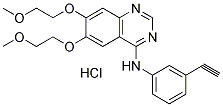
Erlotinib Hydrochloride also known as Tarceva, CP-358774, OSI-774 and NSC-718781, is an inhibitor of human EGFR tyrosine kinase (IC50 = 2 nM) and decreases EGFR autophosphorylation in tumor cells (IC50 = 20 nM). Erlotinib specifically targets the epidermal growth factor receptor (EGFR) tyrosine kinase, which is highly expressed and occasionally mutated in various forms of cancer. It binds in a reversible fashion to the adenosine triphosphate (ATP) binding site of the receptor.
 |
Source | Biochem Biophys Res Commun (2015). Figure 3. Erlotinib Hydrochloride |
| Method | Western blot | |
| Cell Lines | Female BALB/c nude mice | |
| Concentrations | 5 mg/kg | |
| Incubation Time | 24 h | |
| Results | Erlotinib exerts its anti-tumor effect by inhibiting the intracellular phosphorylation of tyrosine kinase which is related to EGFR. We investigated whether the administration time can affect the ability of erlotinib to inhibit the phosphorylation of EGFR. Under non-drugged state, the phosphorylation of EGFR showed obvious oscillation (p < 0.05, Fig. 3A). |
 |
Source | Biochem Biophys Res Commun (2015). Figure 2. Erlotinib Hydrochloride |
| Method | Histopathological analysis | |
| Cell Lines | Female BALB/c nude mice | |
| Concentrations | 5 mg/kg | |
| Incubation Time | 21 d | |
| Results | Large areas of cystic degeneration and inflammatory infiltration can be easily spotted in the tumor tissue of mice given erlotinib at 08:00, 12:00 and 04:00, and the tumor cells arranged irregularly with necrosis and minimal bleeding. |
| Cell Experiment | |
|---|---|
| Cell lines | BxPC-3 and MIAPaCa cells |
| Preparation method | Cell Viability Assay To test the viability of cells treated with B-DIM, erlotinib, or the combination, BxPC-3 and MIAPaCa cells were plated (3,000-5,000 per well) in a 96-well plate and incubated overnight at 37jC. We initially tested a range of concentrations for both B-DIM (10-50 µmol/L) and erlotinib (1-5 µmol/L). Based on the initial results, the concentration of B-DIM (20 Amol/L) and erlotinib (2 Amol/L) were chosen for all assays. The effects of B-DIM (20 µmol/L), erlotinib (2 µmol/L), and the combination on BxPC-3 and MIAPaCa cells were determined by the standard 3-(4,5- dimethylthiazol-2-yl)-2,5-diphenyltetrazolium bromide (MTT) assay after 72 h and was repeated three times. The color intensity was measured by a Tecan microplate fluorometer at 595 nm. DMSO-treated cells were considered to be the untreated control and assigned a value of 100%. |
| Concentrations | 1-5 µmol/L |
| Incubation time | 72 h |
| Animal Experiment | |
|---|---|
| Animal models | SCID mice bearing orthotopically implanted BxPC-3 pancreatic tumor cells |
| Formulation | not mentioned |
| Dosages | 50 mg/kg body weight every day for 15 days |
| Administration | i.p. |
| Molecular Weight | 429.90 |
| Formula | C22H23N3O4.HCl |
| CAS Number | 183319-69-9 |
| Solubility (25°C) | DMSO 3 mg/mL |
| Storage |
Powder -20°C 3 years ; 4°C 2 years In solvent -80°C 6 months ; -20°C 1 month |
| Related EGFR/HER2 Products |
|---|
| Panitumumab
Panitumumab is a fully human IgG2 monoclonal antibody specific to the epidermal growth factor receptor (EGFR). |
| Nimotuzumab
Nimotuzumab (Nimotuzumab) is the first humanized monoclonal antibody targeting epidermal growth factor receptor (EGFR). Nimotuzumab has cytolytic effects on target tumors through its ability to induce antibody-dependent cell-mediated cytotoxicity (ADCC) and complement dependent cytotoxicity (CDC). Nimotuzumab failed to recognize mouse EGFR. |
| Matuzumab
Matuzumab (EMD 72000) is a humanized monoclonal antibody that binds tightly to EGFR. |
| AEE788
AEE788 (NVP-AEE788) is a novel multitargeted HER 1/2 and VEGFR 1/2 receptor family tyrosine kinases inhibitor with IC50 of 2, 6, 77, 59 nM for EGFR, ErbB2, KDR, and Flt-1. |
| Sapitinib (AZD8931)
AZD8931 (Sapitinib) is an equipotent, reversible inhibitor of Signaling by EGFR, ERBB2 (HER2), and ERBB3 with IC50 of 4, 3, 4 nM respectively. |
All AbMole products are for research use only, cannot be used for human consumption or veterinary use. We do not provide products or services to individuals. Please comply with the intended use and do not use AbMole products for any other purpose.


Products are for research use only. Not for human use. We do not sell to patients.
© Copyright 2010-2026 AbMole BioScience. All Rights Reserved.
