
All AbMole products are for research use only, cannot be used for human consumption.
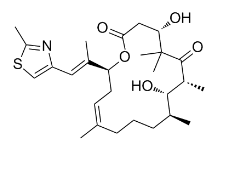
In vitro: Epothilone D (KOS-862) is a more potent microtubule stabilizer in vitro than epothilone A or B. In vitro, Epothilone D has shown potent cytotoxicity in a panel of human tumor cell lines, with similar potency to paclitaxel. Epothilone D also shows a definite advantage over paclitaxel in drug-resistant cell lines, and retained its cytotoxicity against a multidrug resistant cell line over-expressing P-glycoprotein. Epothilone D (EpoD) is a microtubules (MTs)-stabilizing agent.
In vivo: To evaluate whether Epothilone D (EpoD) improves MT and axonal function in PS19 mice, groups of 3-month old male PS19 mice received weekly i.p. injections of vehicle or Epothilone D (1 mg/kg or 3 mg/kg) for a total of 3 months. In addition, 3-month old non-Tg littermates received 3 mg/kg Epothilone D or vehicle. The 3 mg/kg Epothilone D dose corresponds to ~10-fold less than that used in a Phase II clinical study, which should minimize side-effects such as neutropenia that are observed with MT-stabilizing drugs in human subjects. PS19 and WT mice that receive Epothilone D show no signs of drug intolerance. Indeed, all drug-treated mice exhibited weight gain that is indistinguishable from vehicle-treated animals. Likewise, relative organ weights are similar in vehicle- and Epothilone D-treated mice. The motor performance of Epothilone D-treated mice, assessed using a standard rotarod test, is not significantly different from vehicle-treated cohorts. Finally, although there is minor group-to-group variability, there are no significant differences in white blood cell counts or neutrophil content between any of the treatment cohorts. Thus, the low doses of Epothilone D utilized in these studies appeared to be well tolerated.
| Cell Experiment | |
|---|---|
| Cell lines | |
| Preparation method | |
| Concentrations | |
| Incubation time | |
| Animal Experiment | |
|---|---|
| Animal models | Mice |
| Formulation | dissolved in 100% DMSO and diluted with saline or PBS |
| Dosages | 3 mg/kg |
| Administration | i.p. |
| Molecular Weight | 491.68 |
| Formula | C27H41NO5S |
| CAS Number | 189453-10-9 |
| Solubility (25°C) | 10 mM in DMSO |
| Storage |
Powder -20°C 3 years ; 4°C 2 years In solvent -80°C 6 months ; -20°C 1 month |
| Related Microtubule Products |
|---|
| ABT-751
ABT-751 is an orally bioavailable tubulin inhibitor with IC50 of about 1.5 and 3.4 µM in neuroblastoma and non-neuroblastoma cell lines, respectively. |
| Vincristine sulfate
Vincristine, formally known as leurocristine, is a mitotic inhibitor used in cancer chemotherapy. |
| Docetaxel
Docetaxel (Taxotere), a semi-synthetic analog of paclitaxel (Taxol), is a promoter of microtubule polymerization leading to cell cycle arrest at G2/M, apoptosis and cytotoxicity. |
| Paclitaxel
Paclitaxel is a diterpenoid derived from the bark of the plant Picea abies, and is also a microtubule polymer stabilizer, which promotes polymerization of microtubule proteins to inhibit depolymerization, maintains the stability of microtubule proteins, and inhibits cellular mitosis, and acts on human endothelial cells with an IC50 of 0.1 pM. |
| Fosbretabulin disodium
Fosbretabulin disodium (Combretastatin A-4 phosphate) is a microtubule-targeting agent that binds β-tubulin with Kd of 0.4 μM. |
All AbMole products are for research use only, cannot be used for human consumption or veterinary use. We do not provide products or services to individuals. Please comply with the intended use and do not use AbMole products for any other purpose.


Products are for research use only. Not for human use. We do not sell to patients.
© Copyright 2010-2026 AbMole BioScience. All Rights Reserved.
