
All AbMole products are for research use only, cannot be used for human consumption.
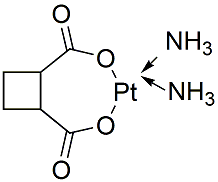
Carboplatin (NSC 241240) is a second-generation platinum compound with a broad spectrum of antineoplastic properties. Carboplatin is activated intracellularly to form reactive platinum complexes that bind to nucleophilic groups such as GC-rich sites in DNA, thereby inducing intrastrand and interstrand DNA cross-links, as well as DNA-protein cross-links. Carboplatin possesses tumoricidal activity similar to that of its parent compound, cisplatin, but is more stable and less toxic. Carboplatin is used against some forms of cancer (mainly ovarian carcinoma, lung, head and neck cancers).
DMSO can inactivate Carboplatin's activity

Int J Mol Sci. 2022 Jun 3;23(11):6290.
Carboplatin-Induced Thrombocytopenia through JAK2 Downregulation, S-Phase Cell Cycle Arrest, and Apoptosis in Megakaryocytes
Carboplatin purchased from AbMole
Int J Oncol. 2020 Jan;56(1):47-68.
Circulating non‑coding RNA‑biomarker potential in neoadjuvant chemotherapy of triple negative breast cancer?
Carboplatin purchased from AbMole
Universitat Freiburg im Breisgau. 2020 Jul.
Investigation of chemotherapy-induced non-coding RNA expression alterations in clinical breast cancer management
Carboplatin purchased from AbMole

Cell Death Dis. 2018 Feb 12;9(2):213.
Autophagy mediates glucose starvationinduced glioblastoma cell quiescence and chemoresistance through coordinating cell metabolism, cell cycle, and survival
Carboplatin purchased from AbMole

Cell Cycle. 2018;17(10):1235-1244.
Apatinib, a novel tyrosine kinase inhibitor, suppresses tumor growth in cervical cancer and synergizes with Paclitaxel.
Carboplatin purchased from AbMole
 |
Source | Cell Cycle (2018 Jul). Figure 5. Carboplatin (Abmole Bioscience) |
| Method | cellular proliferation assay | |
| Cell Lines | SiHa cells | |
| Concentrations | 5 μM | |
| Incubation Time | - | |
| Results | However, we found no synergy between Apatinib and cisplatin (CI ranged from 1.149 to 5.647 in SiHa, CI ranged from 0.85 to 1.682 in Hcc94) or carboplatin (CI ranged from 0.669 to 1.402 in SiHa and from 0.955 to 1.206 in Hcc94) |
 |
Source | Cell Death Dis (2018). Figure 3. Carboplatin (Abmole Bioscience) |
| Method | Glucose starvation sensitizes glioblastoma cells to chemotherapies | |
| Cell Lines | U87 and U251 cells | |
| Concentrations | 50 μM | |
| Incubation Time | 5 d | |
| Results | Treatment with either temozolomide or carboplatin induced about 50 and 80% GBM cell death under normal and glucose starvation conditions, respectively |
 |
Source | Cell Death Dis (2018). Figure 1. Carboplatin (Abmole Bioscience) |
| Method | Glucose starvation sensitizes glioblastoma cells to chemotherapies | |
| Cell Lines | U87 and U251 cells | |
| Concentrations | 50 μM | |
| Incubation Time | 5 d | |
| Results | The cytotoxic effect was progressive and by day 5, temozolomide or carboplatin treatment caused 40–60% cell loss in U87 and U251 cells. Glucose starvation nearly doubled the cell loss to 70–90%. |
 |
Source | Mol Oncol (2014). Figure 4. Carboplatin |
| Method | s.c. | |
| Cell Lines | Female 6-week-old nude mice | |
| Concentrations | 100 mg/kg | |
| Incubation Time | 5 weeks | |
| Results | Both carboplatin treatment groups showed significantly reduced tumor burden as compared to the untreated controls from weeks 4 to 10 (P < 0.0001) |
| Cell Experiment | |
|---|---|
| Cell lines | 5637 cells |
| Preparation method | Cells were dosed and incubated with 290 μM carboplatin or 290 μM carboplatin combined with 0.08 μM paclitaxel for 4 h, each including 0.43 μM[14C]carboplatin (106 dpm/ml). After washing, cells were maintained with 14C carboplatin-free culture media. DNA was extracted from cells and converted to graphite and measured by AMS for 14C quantification as previously described. |
| Concentrations | 290 μM |
| Incubation time | 4 h |
| Animal Experiment | |
|---|---|
| Animal models | Female 6‐week‐old nude mice |
| Formulation | |
| Dosages | 100 mg/kg |
| Administration | s.c. |
| Molecular Weight | 371.25 |
| Formula | C6H12N2O4Pt |
| CAS Number | 41575-94-4 |
| Solubility (25°C) | Water 4 mg/mL warmed DMF 1 mg/mL (Need ultrasonic) |
| Storage | 4°C, protect from light, sealed |
| Related DNA/RNA Synthesis Products |
|---|
| Clofarabine
Clofarabine inhibits the enzymatic activities of ribonucleotide reductase (IC50 = 65 nM) and DNA polymerase. |
| Gemcitabine Hydrochloride
Gemcitabine (Gemzar, LY188011) inhibits DNA synthesis with an IC50 of 0.06 µM. |
| Nelarabine
Nelarabine is a novel purine antimetabolite antineoplastic agent. |
| Mizoribine
Mizoribine (Bredinin) is an imidazole nucleoside and an immunosuppressive agent with an IC50 of approximately 100 μM. Mizoribine inhibits replication of SARS-CoV with IC50s of 3.5 μg/mL and 16 μg/mL for SARS-CoV Frankfurt-1 and SARS-CoV HKU39849, respectively. |
| Capecitabine
Capecitabine is an orally-administered chemotherapeutic agent. Capecitabine is a precursor, that is enzymatically converted to 5-fluorouracil in the tumor, where it inhibits DNA synthesis and slows growth of tumor tissue. Capecitabine may inhibit cytochrome CYP2C9 enzyme, and therefore increase levels of substrates such as phenytoin and other substrates of CYP2C9. |
All AbMole products are for research use only, cannot be used for human consumption or veterinary use. We do not provide products or services to individuals. Please comply with the intended use and do not use AbMole products for any other purpose.


Products are for research use only. Not for human use. We do not sell to patients.
© Copyright 2010-2026 AbMole BioScience. All Rights Reserved.
