
All AbMole products are for research use only, cannot be used for human consumption.
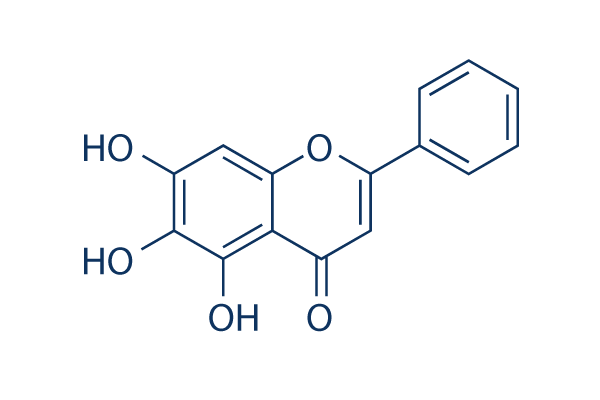
In vitro: Baicalein suppresses mitogen induced T cell proliferation and cytokine secretion in vitro. Pre-treatment with baicalein significantly suppresses Con A or anti-CD3/CD28 mAb induced proliferation as well as cytokine secretion at 25 μM. Baicalein treatment induces DNA binding of NF-κB but inhibits thioredoxin activity in the nuclear compartment. Baicalein suppresses proliferation, migration, and invasion of MDA-MB-231 cells in a time- and dose-dependent manner. Baicalein significantly decreases the expression of SATB1 in MDA-MB-231 cells. Baicalein also downregulates the expression of Wnt1 and β-catenin proteins and transcription level of Wnt/β-catenin-targeted genes. In vivo: Baicalein suppresses induction of graft versus host disease but does not inhibit homeostatic proliferation of T-cells in mice. This observation clearly shows potent anti-inflammatory activity of baicalein in vivo. Rats treated with baicalein are protected against an increase in heart to body weight ratio, plasma level of brain natriuretic peptides, intraventricular septum thickness, myocardial collagen volume of left ventricle (all P<0.05, respectively). The antifibrotic effects of baicalein are further illustrated by the suppressed expression of left ventricle pro-collagens I and III accompanied by the decreased expression of 12-lipoxygenase, and by reduced expression and activity of matrix metallopeptidase 9 and extracellular signal-regulated kinases. Baicalein can inhibit cardiac fibrosis in hypertensive rats.

Phytomedicine. 2024 Feb 16.
Baicalein improves the symptoms of polycystic ovary syndrome by mitigating oxidative stress and ferroptosis in the ovary and gravid placenta
Baicalein purchased from AbMole
Trop J Pharm Res. 2020 Nov;Vol. 19 No. 7.
Baicalein inhibits cell development in papillary thyroid cancer by regulating miR-206/RAP1B pathway
Baicalein purchased from AbMole
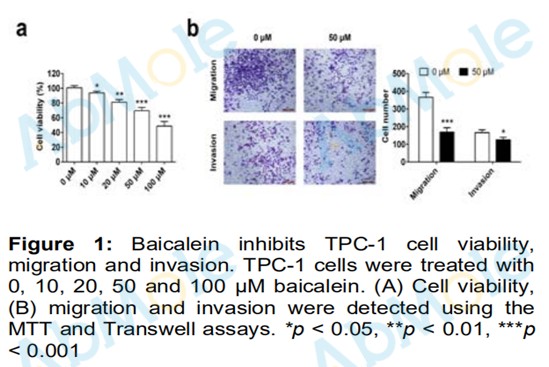 |
Source | Tropical Journal of Pharmaceutical Research 2020 Nov. Figure 1. baicalein (Abmole Bioscience Inc, Houston, TX, USA) |
| Method | Cell culture and treatment | |
| Cell Lines | The human PTC cell line TPC-1 | |
| Concentrations | 10, 20, 50, or 100 μM | |
| Incubation Time | 72 h | |
| Results | The Transwell assay showed that the number of migrating or invading cells in the 50 μM baicalein group was less than that in the 0 μM baicalein group |
| Cell Experiment | |
|---|---|
| Cell lines | MDA-MB-231 cells |
| Preparation method | MDA-MB-231 cells are routinely digested, collected, and then seeded in 96-well plates at a density of 8×10^3 cells/well. After incubation for 12-24 hours, cells are treated with 0, 20, 40, 60, 80, 100, and 120 μM baicalein according to their experimental grouping and then incubated at 37°C for 24, 48, and 72 hours |
| Concentrations | 0, 20, 40, 60, 80, 100, and 120 μM |
| Incubation time | 12-24 h |
| Animal Experiment | |
|---|---|
| Animal models | Female (age 6–8 weeks) athymic nude mice |
| Formulation | dissolved in 10% DMSO and 90% sesame oil to form an emulsion |
| Dosages | 25 mg/kg |
| Administration | i.p. |
| Molecular Weight | 270.24 |
| Formula | C15H10O5 |
| CAS Number | 491-67-8 |
| Solubility (25°C) | 54 mg/mL in DMSO |
| Storage | 2-8°C, protect from light |
| Related Products |
|---|
| Lactate calcium
Lactate calcium is an excellent calcium fortifier that works better than inorganic calcium. Lactate calcium is used as an antacid. |
| Coniferyl ferulate
Coniferyl ferulate is a potent glutathione S-transferase (GST) inhibitor that reverses multidrug resistance and down-regulates p-glycoprotein. Coniferyl ferulate strongly inhibited human placental glutathione S-transferase with IC50 of 0.3 μM. |
| NXY-059
NXY-059 is a free radical-trapping neuroprotectant that has been reported to reduce infarct size and preserve brain function in experimental models of acute ischemic stroke. |
| Tie2 kinase inhibitor
Tie2 kinase inhibitor is a potent, reversible, and ATP-binding site-targeting Tie2 inhibitor with an IC50 of 250 nM. |
| Calcium levofolinate
Calcium levofolinate is a calcium salt of folinic acid that is an adjuvant used in cancer chemotherapy. |
All AbMole products are for research use only, cannot be used for human consumption or veterinary use. We do not provide products or services to individuals. Please comply with the intended use and do not use AbMole products for any other purpose.


Products are for research use only. Not for human use. We do not sell to patients.
© Copyright 2010-2026 AbMole BioScience. All Rights Reserved.
