
All AbMole products are for research use only, cannot be used for human consumption.
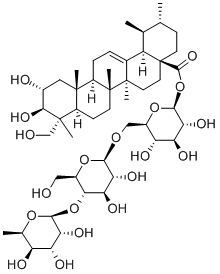
Asiaticoside is effective in vitro and in vivo in inducing apoptosis and enhancing anti-tumour activity. Asiaticoside treatment may have beneficial effects in hyperpigmentation diseases or for skin whitening. Asiaticosides could inhibit TGF-beta expression, significantly decrease the synthesis and secretion of extracellular matrix, further inhibit the post-stenting intima-media membrane hyperplasia and reduce the endothelial cell damage by effectively up-regulate the expression of Smad7 protein. In vivo studies demonstrated that Asiaticoside could attenuate neurobehavioral, neurochemical and histological changes in transient focal middle cerebral artery occlusion animals. In addition, Asiaticoside showed anxiolytic effects in acute and chronic stress animals. Pretreatment with Asiaticoside decreased neuronal cell loss in a concentration-dependent manner and restored changes in expression of apoptotic-related proteins Bcl-2 and Bax. In cultured neurons, Asiaticoside significantly inhibited Ca(2+) influx induced by N-methyl-D-aspartate.
| Molecular Weight | 959.12 |
| Formula | C48H78O19 |
| CAS Number | 16830-15-2 |
| Solubility (25°C) | DMSO 30 mg/mL |
| Storage |
Powder -20°C 3 years ; 4°C 2 years In solvent -80°C 6 months ; -20°C 1 month |
[1] Qi FY, et al. Neural Regen Res. Neuroprotective effects of Asiaticoside.
[4] Al-Saeedi FJ. BMC Cancer. Study of the cytotoxicity of asiaticoside on rats and tumour cells.
| Related TGF-beta/Smad Products |
|---|
| Pirfenidone
Pirfenidone (AMR69) is an antifibrotic agent that attenuates CCL2 and CCL12 production in fibrocyte cells. Pirfenidone inhibits TGF-β bioactivity by affecting TGF-β2 mRNA expression and processing of pro-TGF-β in CCL-64 cells. Pirfenidone (AMR69) attenuates CCL2 and CCL12 production in fibrocyte cells. |
| Amygdalin
Laetrile is a glycoside initially isolated from the seeds of the tree Prunus dulcis, also known as bitter almonds. |
| Norcantharidin
Norcantharidin |
| Kartogenin
Kartogenin is an activator of the smad4/smad5 pathway, and promotes the selective differentiation of multipotent mesenchymal stem cells into chondrocytes. |
| SIS3 hydrochloride
SIS3 hydrochloride is a novel specific inhibitor of TGF-β1/ALK-5 phosphorylation of Smad3 with an IC50 of 3 µM. |
All AbMole products are for research use only, cannot be used for human consumption or veterinary use. We do not provide products or services to individuals. Please comply with the intended use and do not use AbMole products for any other purpose.


Products are for research use only. Not for human use. We do not sell to patients.
© Copyright 2010-2026 AbMole BioScience. All Rights Reserved.
