
All AbMole products are for research use only, cannot be used for human consumption.
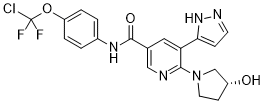
Asciminib (ABL001) selectively inhibited the growth of CML and Ph+ ALL cells with potencies ranging from 1-10nM range. Asciminib was tested for activity against clinically observed mutations and found to be active in the low nM range. In the KCL-22 mouse xenograft model, Asciminib displayed potent anti-tumor activity with complete tumor regression observed and a clear dose-dependent correlation with pSTAT5 inhibition. The oral bioavailability of ABL001 in mouse and rat are 35% and 27% respectively when dosed at 30 mg/kg p.o. While in dogs the oral BA of ABL001 is 111% (15 mg/kg, p.o).
| Molecular Weight | 449.84 |
| Formula | C20H18ClF2N5O3 |
| CAS Number | 1492952-76-7 |
| Solubility (25°C) | DMSO 90 mg/mL |
| Storage |
Powder -20°C 3 years ; 4°C 2 years In solvent -80°C 6 months ; -20°C 1 month |
[1] Wylie AA, et al. Nature. The allosteric inhibitor ABL001 enables dual targeting of BCR-ABL1.
| Related Src-bcr-Abl Products |
|---|
| AP24534
Ponatinib (AP24534) is a novel potent, orally available small molecule multitargeted kinase inhibitor of BCR-ABL, PDGFRα, c-Src, c-Kit, FGFR and VEGFR. |
| Saracatinib
Saracatinib (AZD0530) is an orally active small molecule Src inhibitor. |
| Bosutinib
Bosutinib (SKI-606) is a novel Bcr-Abl inhibitor with IC50 values of 0.1 to 0.3 umol/L. |
| Dasatinib
Dasatinib (BMS-354825) is a small molecule inhibitor of both the SRC and BCR/ABL tyrosine kinases, with IC50's for the isolated kinases of 0.55 and 3.0 nM, respectively. |
| DCC-2036
DCC-2036 is an ABL inhibitor with IC50 of 0.8 and 2 nM for u-ABL1native and p-ABL1native, respectively. |
All AbMole products are for research use only, cannot be used for human consumption or veterinary use. We do not provide products or services to individuals. Please comply with the intended use and do not use AbMole products for any other purpose.


Products are for research use only. Not for human use. We do not sell to patients.
© Copyright 2010-2026 AbMole BioScience. All Rights Reserved.
