
All AbMole products are for research use only, cannot be used for human consumption.
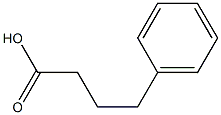
4-Phenylbutyric acid is an inhibitor of HDAC, inhibits the growth of NSCLC Cell Lines at 2 mM. 4-Phenylbutyric acid is also an inhibitor of endoplasmic reticulum (ER) stress. 4-Phenylbutyric acid (0-5 mM) inhibits ASFV infection in a dose-dependent manner. LPS decreases the level of p62, whereas 4-Phenylbutyric acid reverses this decrease upon LPS stimulation for 48 h. The percentage of cells with LPS-induced AVOs is increased at 48 h, whereas 4-Phenylbutyric acid significantly reduces this percentage. Specifically, the percentage of cells with AVOs decreases from 61.6% to 53.1% upon 4-Phenylbutyric acid treatment, supporting that 4-Phenylbutyric acid inhibits LPS-induced autophagy.

Phytother Res. 2026 Jan 20; .
Berberine Reduces Atrial Lipotoxicity and Endoplasmic Reticulum Stress to Alleviate Heart Failure With Preserved Ejection Fraction (HFpEF)‐Associated Atrial
4-Phenylbutyric acid (4-PBA) purchased from AbMole
Journal of Environmental Sciences. 2025 Sep 26; .
SeMet attenuates TBBPA-induced hepatocyte injury via inhibiting endoplasmic reticulum stress
4-Phenylbutyric acid (4-PBA) purchased from AbMole
J Ethnopharmacol. 2025 Sep 26; .
Salidroside improves hypoxia-induced milk synthesis disorder and endoplasmic reticulum stress via AKT/mTOR signaling in bovine mammary epithelial cells
4-Phenylbutyric acid (4-PBA) purchased from AbMole
Veterinary Sciences. 2025 Dec 11; .
NEFA Promotes Bovine Granulosa Cell Apoptosis via Activation of the PERK/eIF2α/ATF4/CHOP Pathway
4-Phenylbutyric acid (4-PBA) purchased from AbMole
Pestic Biochem Physiol. 2024 Dec 28.
An in-depth analysis of the effects of excessive acetochlor exposure on chicken liver health
4-Phenylbutyric acid (4-PBA) purchased from AbMole
Small. 2023 Mar 12;e2208063.
2D MoS2 Nanosheets Induce Ferroptosis by Promoting NCOA4-Dependent Ferritinophagy and Inhibiting Ferroportin
4-Phenylbutyric acid (4-PBA) purchased from AbMole
New Phytol. 2023 Aug 22.
Orosomucoid proteins limit endoplasmic reticulum stress in plants
4-Phenylbutyric acid (4-PBA) purchased from AbMole
J Cell Physiol. 2023 Jan;238(1):151-164.
Polystyrene nanoplastics aggravates lipopolysaccharide-induced apoptosis in mouse kidney cells by regulating IRE1/XBP1 endoplasmic reticulum stress pathway via oxidative stress
4-Phenylbutyric acid (4-PBA) purchased from AbMole
Chemosphere. 2022 Nov;307(Pt 2):135962.
Fine particulate matter induces heart defects via AHR/ROS-mediated endoplasmic reticulum stress
4-Phenylbutyric acid (4-PBA) purchased from AbMole
Am J Pathol. 2021 Dec 5;192:468-483.
The role of inactivated NF-κB in the occurrence of premature ovarian failure
4-Phenylbutyric acid (4-PBA) purchased from AbMole
| Molecular Weight | 164.2 |
| Formula | C10H12O2 |
| CAS Number | 1821-12-1 |
| Solubility (25°C) | DMSO ≥ 30 mg/mL Water 3 mg/mL at 40 ºC |
| Storage | 2-8°C, dry, protect from light, sealed |
| Related HDAC Products |
|---|
| Belinostat
Belinostat (PXD101) is a novel HDAC inhibitor with an IC50 of 27 nM. |
| CUDC-101
CUDC-101 is a potent multitargeted HDAC, EGFR and HER2 inhibitor with IC50 of 4.4, 2.4, and 15.7 nM, respectively. |
| Givinostat hydrochloride monohydrate
ITF2357 (Givinostat, Gavinostat) is a histone deacetylase inhibitor. The IC50 values for maize HDAC preparations HD2, HD-1B and HD-1A are 10, 7.5 and 16 nM respectively. |
| Niltubacin
Niltubacin, as an inactive derivative of Tubacin, is a highly potent and selective, reversible cell-permeable inhibitor of HDAC6. |
| Tubacin
Tubacin (Tubulin Acetylation Inducer) is a highly potent and selective, reversible cell-permeable inhibitor of HDAC6 with IC50 of 0.004µM. |
All AbMole products are for research use only, cannot be used for human consumption or veterinary use. We do not provide products or services to individuals. Please comply with the intended use and do not use AbMole products for any other purpose.


Products are for research use only. Not for human use. We do not sell to patients.
© Copyright 2010-2026 AbMole BioScience. All Rights Reserved.
